Computed attribute
Like many storage solutions, Casewhere supports computed attributes. Instead of accepting values set by applications, Casewhere computes values from given expressions. Computed attributes are persisted in the database, so features like indexing and searching work as designed.
Configuration
In the data class editor, select an attribute and set Computed to True. It's possible to enable Computed for any data attribute.
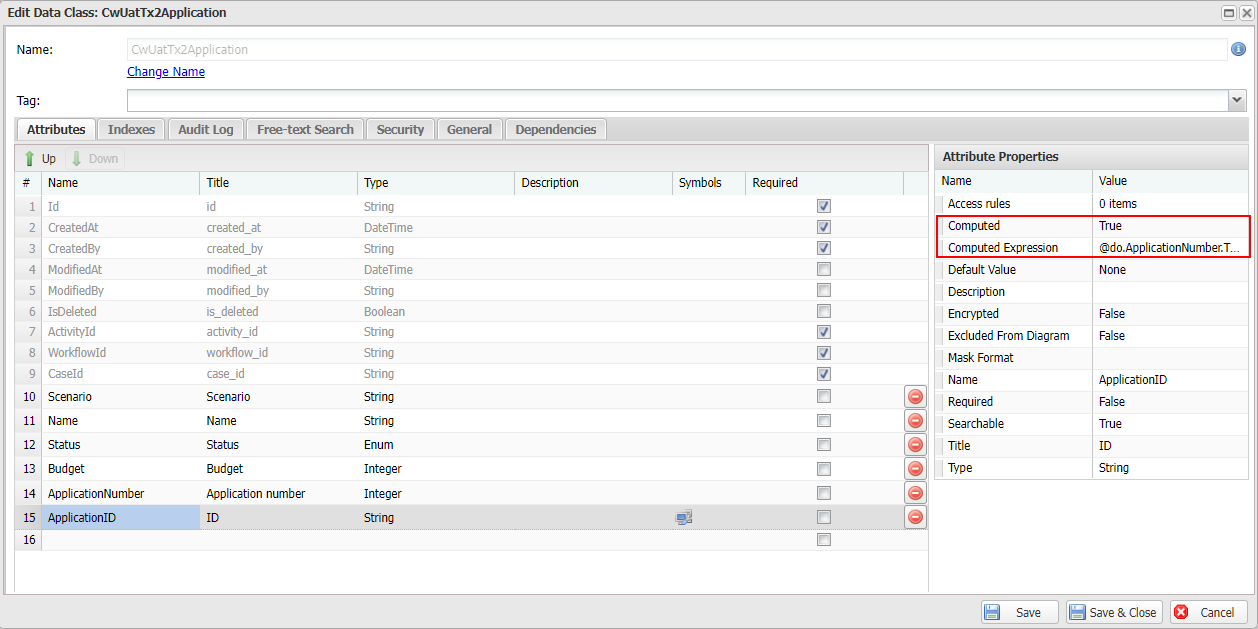
After turning on the Computed setting, you will need to provide a Computed Expression, which Casewhere will use to compute the value. The expression is a simple C# expression, accepting the keyword @do, which is used for accessing the data object attributes. Please note that you can only compute data from other existing data attributes.
Example 1: Compute full name from first name and last name
@do.FirstName + ", " + @do.LastName // "Jone, Doe"
Example 2: Compute a friendly id from an auto-increment value
@do.ApplicationNumber.ToString().PadLeft(5, '0') // "00018", "00019", ...
Auto-increment attribute
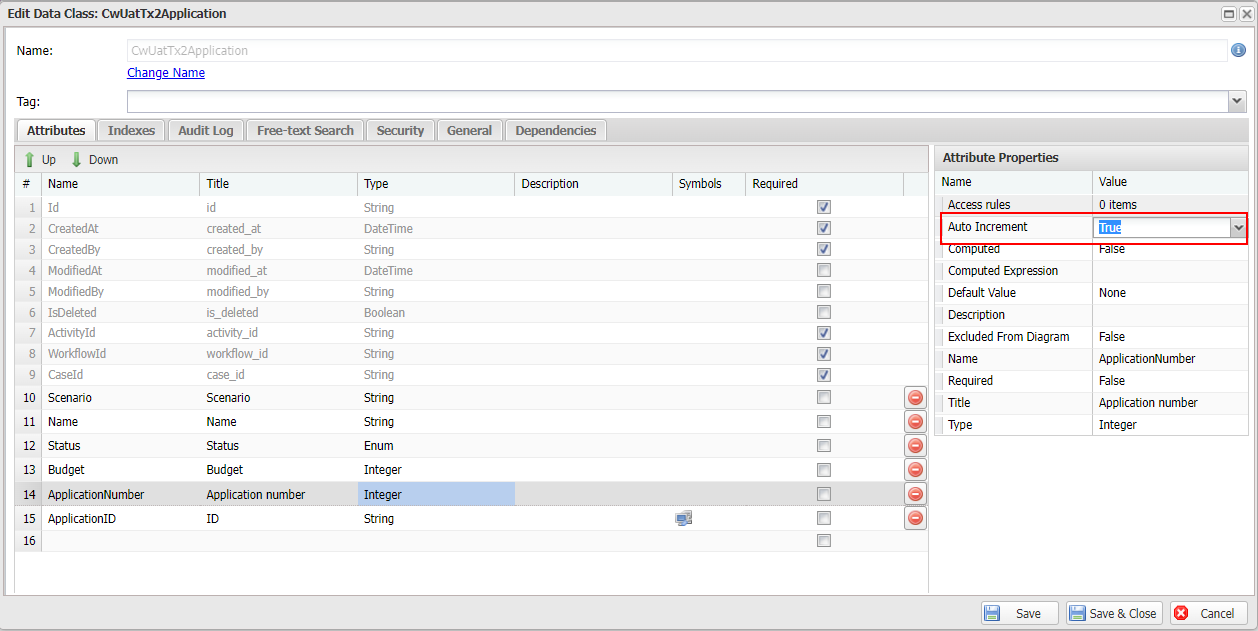
Auto-increment automatically assigns a unique, incrementing number to each new data object, and is available for Integer and Long attributes only. It is a distinct feature from a computed attribute — you enable it with its own Auto Increment setting rather than a computed expression. In the data class editor, select an Integer or Long attribute and set Auto Increment to True. When the setting is turned on, Casewhere will assign a new unique number when a new data object is created. The starting value is 1, and it will increment by 1 for each new data object.